MAGMA (HBA) (DECODE (Seropositive), RA)
I applied MAGMA1 to summary statistics from DECODE's meta-GWAS of seropositive rheumatoid arthritis2, using scRNAseq data from the Human Brain Atlas (HBA) as a reference3. As in my other MAGMA analyses, I sourced linkage disequilibrium reference data from the European subset of the 1000-genomes project. I used a MAGMA gene/cell specificity matrix (i.e. the \(E\) matrix in my notes on MAGMA ) prepared as described in Duncan et al.4
Results
The results are plotted below, first as a static image, then as an interactive plot:
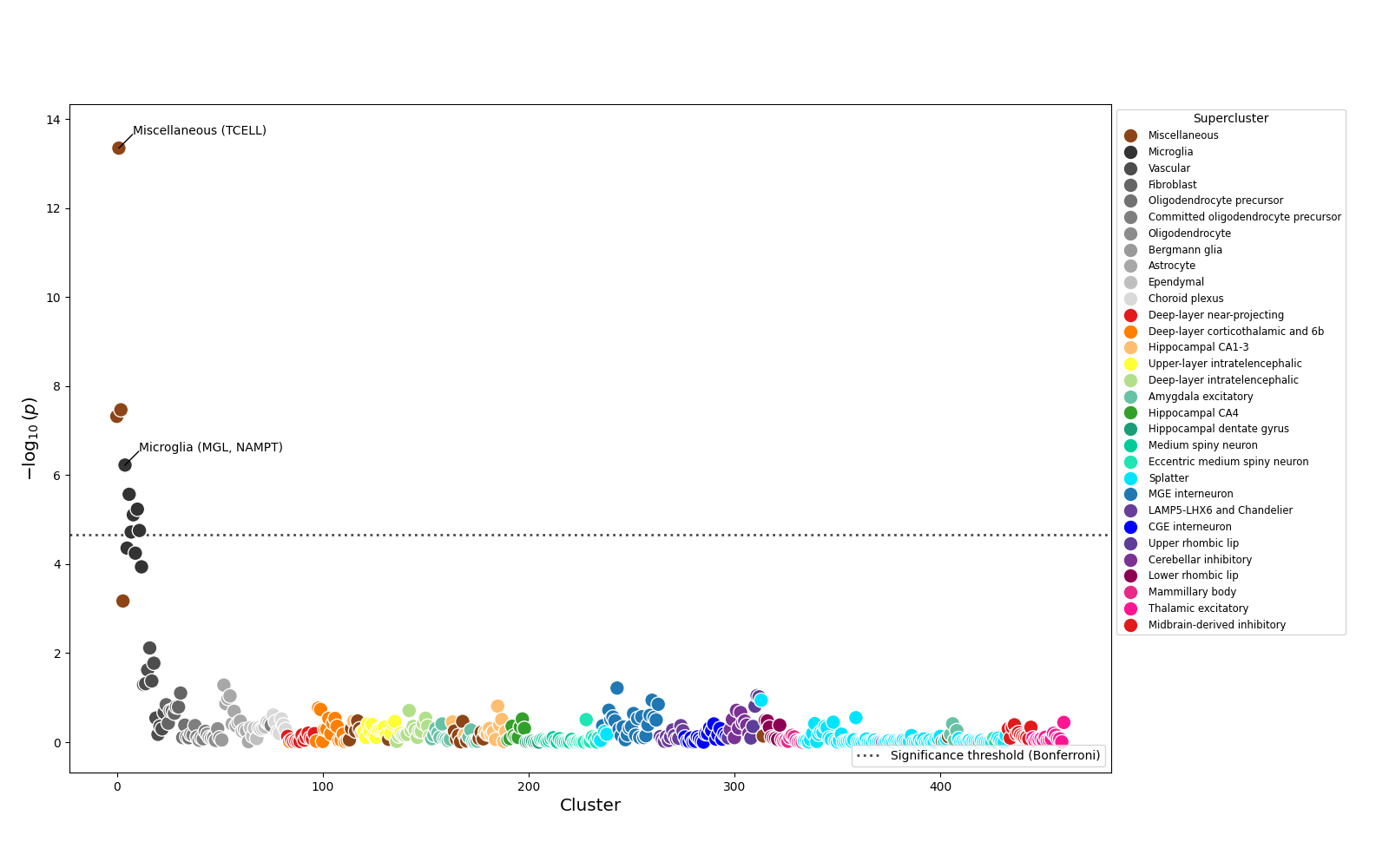
The x-axis corresponds to HBA cluster number3, while the y-axis corresponds to the \(-\log_{10}(p)\) score generated by MAGMA. Clusters are colored according to their HBA supercluster. The dotted line denotes the Bonferroni significance threshold. I used a conditional analysis approach based on the one described in Wanatabe et al.5 to identify independent clusters. These 2 independent clusters are labeled in the static plot.
It is notable that two independent clusters are immune cell types (T cells and Microglia), consistent with the status of rheumatoid arthritis as an autoimmune disease. It is likely that the signal represented by these clusters is not brain-specific, but reflects global enrichment of immune pathways in the RA summary statistics.
-
Nancy YA Sey, Benxia Hu, Won Mah, Harper Fauni, Jessica Caitlin McAfee, Prashanth Rajarajan, Kristen J Brennand, Schahram Akbarian, and Hyejung Won. A computational tool (H-MAGMA) for improved prediction of brain-disorder risk genes by incorporating brain chromatin interaction profiles. Nature Neuroscience, 23(4):583–593, 2020. URL: https://pmc.ncbi.nlm.nih.gov/articles/PMC7131892/. ↩
-
Saedis Saevarsdottir, Lilja Stefansdottir, Patrick Sulem, Gudmar Thorleifsson, Egil Ferkingstad, Gudrun Rutsdottir, Bente Glintborg, Helga Westerlind, Gerdur Grondal, Isabella C Loft, and others. Multiomics analysis of rheumatoid arthritis yields sequence variants that have large effects on risk of the seropositive subset. Annals of the rheumatic diseases, 81(8):1085–1095, 2022. URL: https://www.sciencedirect.com/science/article/pii/S0003496724209766. ↩
-
Kimberly Siletti, Rebecca Hodge, Alejandro Mossi Albiach, Ka Wai Lee, Song-Lin Ding, Lijuan Hu, Peter Lönnerberg, Trygve Bakken, Tamara Casper, Michael Clark, and others. Transcriptomic diversity of cell types across the adult human brain. Science, 382(6667):eadd7046, 2023. URL: https://www.science.org/doi/abs/10.1126/science.add7046. ↩↩
-
Laramie E Duncan, Tayden Li, Madeleine Salem, Will Li, Leili Mortazavi, Hazal Senturk, Naghmeh Shahverdizadeh, Sam Vesuna, Hanyang Shen, Jong Yoon, and others. Mapping the cellular etiology of schizophrenia and complex brain phenotypes. Nature Neuroscience, 28(2):248–258, 2025. URL: https://www.nature.com/articles/s41593-024-01834-w. ↩
-
Kyoko Watanabe, Maša Umićević Mirkov, Christiaan A de Leeuw, Martijn P van den Heuvel, and Danielle Posthuma. Genetic mapping of cell type specificity for complex traits. Nature Communications, 10(1):3222, 2019. URL: https://www.nature.com/articles/s41467-019-11181-1. ↩