PPP Colocalization (DecodeME, ME/CFS)
Overview
I used ABF colocalization1 to search for loci at which DecodeME GWAS-12 colocalized with Olink3 proteomic GWAS from the European discovery cohort of the UK Biobank Pharma Proteomics Project (UKBB PPP)4.
Results
This was an exploratory analysis, so I included all DecodeME loci at which the lead DecodeME variant had a p value less that \(10^{-5}\). Note that this is a looser threshold than is normally used for genome-wide significance. The main results follow. The table below includes all protein/ locus pairs at which the probability of colocalization exceeds 80%.
Results of colocalization analysis. Columns: protein: name of the protein. assay_id: ID of proteomic assay. locus: genomic interval used for colocalization. lead: most significant trait variant in locus. cis: cis means the locus is within 1 Mb of the gene coding for the protein. Trans means the locus is more than 1Mb from that gene. Unknown means data required to make this determination is missing. pp_h4: posterior probability that the trait and protein GWAS share a causal variant at the locus. Note that this is prior-dependent. q: The expected number of false discoveries if this row and all rows with larger pp_h4 are counted as discoveries. fdr_sig: whether this row will be included in the discovery set if we cap the Bayesian false discovery rate at 0.05. trait_p: p value of the most significant trait variant at the locus. prot_p: p value of the most significant protein variant at the locus. same_sign: whether the trait and protein effects have the same sign at the most significant protein variant. n_snp: number of variants present in trait and protein GWAS at the locus.
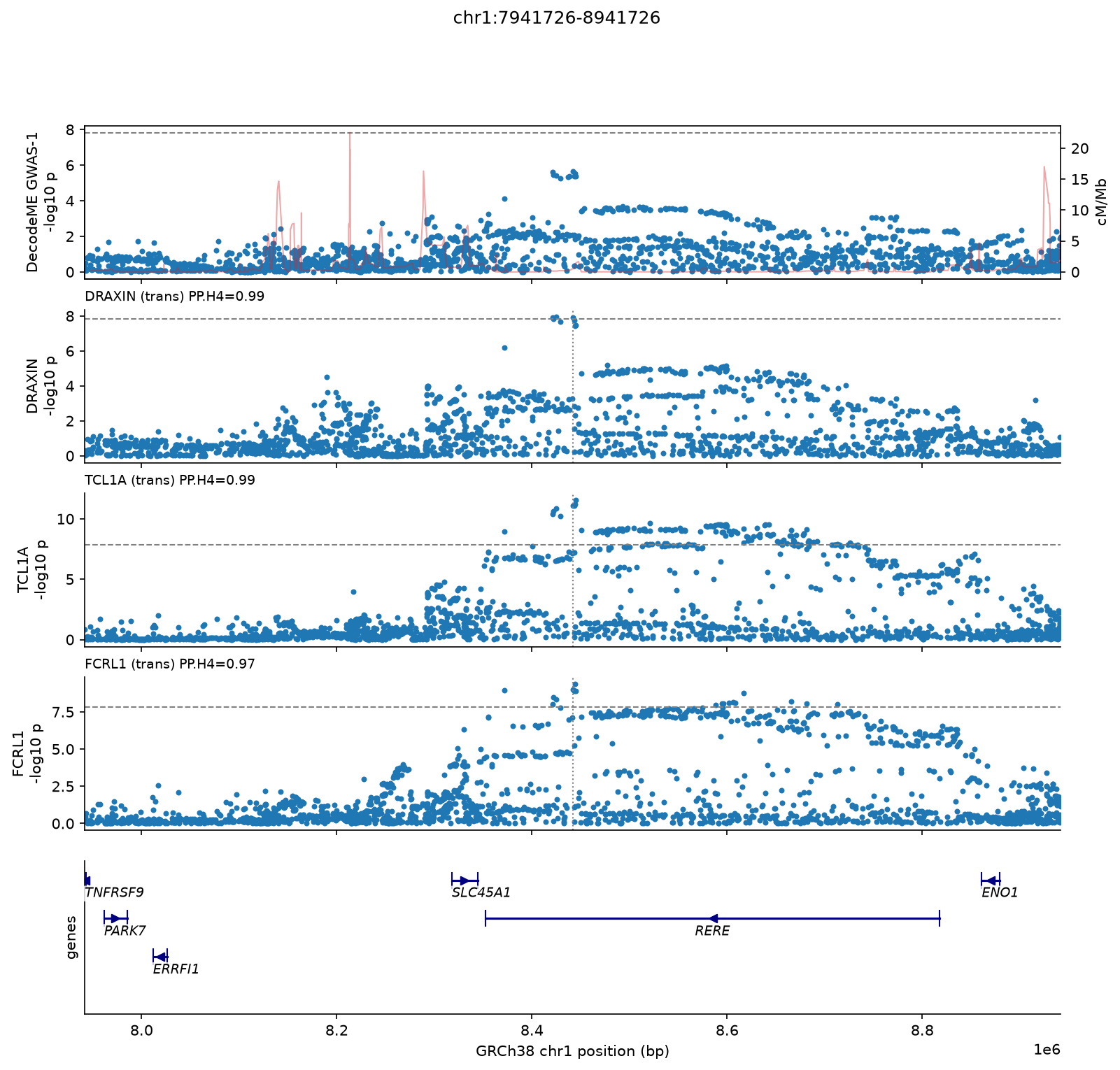
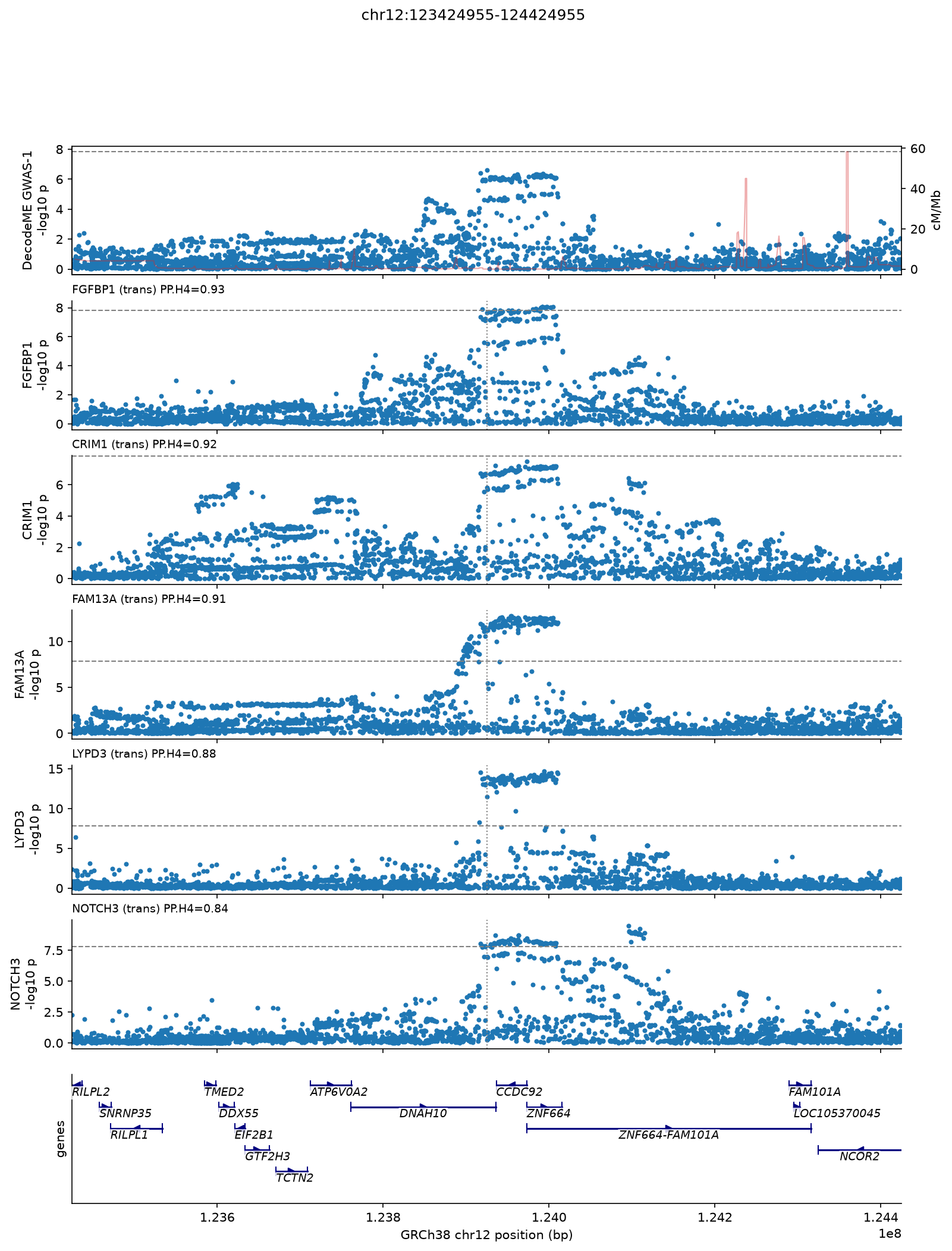
As the table shows, while DecodeME did not colocalize with proteomic GWAS at any of the DecodeME genome-wide-significant loci, there was colocalization at two sub-genome-wide-significant loci.
Below, I show Manhattan plots from DecodeME and the relevant proteomic GWAS at these loci:
I looked up the colocalizing proteins in proteomics databases:
It is notable that both DRAXIN and CRIM1 pertain to nervous system development.
Caveats
Trans versus cis pQTL: Note that DecodeME colocalizes with trans-pQTL (defined as pQTLs more than 1Mb from the gene coding for the protein) rather than cis-pQTL (defined as pQTLs within 1Mb of the gene coding for the protein). Colocalization with cis-pQTL is generally much more mechanistically informative than colocalization with trans-pQTL. This is because cis-pQTLs can be reasonably assumed to affect protein levels by directly regulating the synthesis of the protein in question, while a trans-pQTL may perturb a complex regulatory network in a way that changes protein levels only as a remote downstream consequence (see Omnigenic model).
Thus when a trait GWAS colocalizes with a cis-pQTL, we may infer a causal graph like this:
graph LR
A(Variant) --> B(Protein level);
B  --> C(Trait)

classDef normal fill:transparent,stroke:transparent;
classDef conditioned fill:transparent,stroke:#444,stroke-width:2px;
class A,B,C normal;
However, since DecodeME colocalizes with only trans-pQTL, the true causal graph may instead resemble:
graph LR
A(Variant) --> B(Regulatory Network);
B  --> C(ME/CFS)
B  --> D(DRAXIN, TCL1A, FCRL1 levels)

classDef normal fill:transparent,stroke:transparent;
classDef conditioned fill:transparent,stroke:#444,stroke-width:2px;
class A,B,C,D normal;
Bayesian Prior: Like any Bayesian method, ABF colocalization is sensitive to its prior. The above analysis was based on the widely-used default ABF colocalization prior. However, some authors have argued that this default prior is insufficiently conservative.
Multiple testing: To handle multiple testing, I used a Bayesian false discovery rate approach. However, this is not as conservative as standard frequentist multiple testing correction. Since I tested so many proteins, use of a "skeptical prior" might be justified here, but it would be hard to choose a-priori how skeptical to make it.
Single causal variant assumption: ABF colocalization depends on the assumption that each GWAS has at most one causal variant at each locus. Eyeballing the Manhattan plots above suggests this assumption is reasonable for the loci in question, but it could be worthwhile to apply a method like SUSIE-coloc, which allows for multiple causal variants per locus.
Participant overlap: The mathematical derivation of ABF colocalization relies on there being no overlap between the participants in the two GWAS being colocalized. The PPP proteomics GWAS used UK Biobank participants, while DecodeME controls were also drawn from the UK Biobank. Thus technically the above analysis violates the assumptions underlying ABF colocalization. Because the overlap is only partial, I do not expect that this had a major impact on our results. Nevertheless, it is worth investigating. Attempting to replicate the above results using another proteomics GWAS that does not have participant overlap with DecodeME would be worthwhile.
Sub-significant loci: The loci at which we found a high probability of colocalization did not meet the standard genome-wide significance threshold of \(p<5 \times 10^{-8}\) in DecodeME. It is possible, though unlikely, that the DecodeME signal at these loci is spurious.
Comparison with proteomics CT-LDSC study: Previously, I ran a CT-LDSC screen of all PPP proteins against DecodeME. None of the proteins that colocalized with DecodeME in the above analysis were found to be significantly genetically correlated with DecodeME in that CT-LDSC study. CT-LDSC measures global, polygenic overlap of genetic architecture, whereas ABF colocalization measures local matching of causal variants. We can therefore conclude that that matching between DecodeME and these proteins is purely local.
Next steps
- Investigating what is known about regulatory pathways involving the colocalizing proteins could be informative.
- Besides PPP, there are other large scale proteomics GWAS, such as Western et al.5 and the deCODE proteomics study6. These proteomics GWAS use different technologies (SomaScan instead of Olink), different participants, and in the case of Western et al. a different bodily site (Western et al. uses cerebro-spinal fluid instead of plasma). Comparing colocalization results generated with these proteomic GWAS to the above PPP colocalization results could be revealing.
-
Claudia Giambartolomei, Damjan Vukcevic, Eric E Schadt, Lude Franke, Aroon D Hingorani, Chris Wallace, and Vincent Plagnol. Bayesian test for colocalisation between pairs of genetic association studies using summary statistics. PLoS genetics, 10(5):e1004383, 2014. URL: https://journals.plos.org/plosgenetics/article?id=10.1371/journal.pgen.1004383. ↩
-
Genetics Delivery Team, Thibaud Boutin, Andrew D Bretherick, Joshua J Dibble, Esther Ewaoluwagbemiga, Emma Northwood, Gemma L Samms, Veronique Vitart, Project, Cohort Delivery Team, Øyvind Almelid, and others. Initial findings from the DecodeME genome-wide association study of myalgic encephalomyelitis/chronic fatigue syndrome. medRxiv, pages 2025–08, 2025. URL: https://www.medrxiv.org/content/10.1101/2025.08.06.25333109v1. ↩
-
Lotta Wik, Niklas Nordberg, John Broberg, Johan Björkesten, Erika Assarsson, Sara Henriksson, Ida Grundberg, Erik Pettersson, Christina Westerberg, Elin Liljeroth, and others. Proximity extension assay in combination with next-generation sequencing for high-throughput proteome-wide analysis. Molecular & Cellular Proteomics, 20:100168, 2021. URL: https://www.sciencedirect.com/science/article/pii/S1535947621001407. ↩
-
Benjamin B Sun, Joshua Chiou, Matthew Traylor, Christian Benner, Yi-Hsiang Hsu, Tom G Richardson, Praveen Surendran, Anubha Mahajan, Chloe Robins, Steven G Vasquez-Grinnell, and others. Plasma proteomic associations with genetics and health in the UK Biobank. Nature, 622(7982):329–338, 2023. URL: https://www.nature.com/articles/s41586-023-06592-6. ↩
-
Daniel Western, Jigyasha Timsina, Lihua Wang, Ciyang Wang, Chengran Yang, Bridget Phillips, Yueyao Wang, Menghan Liu, Muhammad Ali, Aleksandra Beric, and others. Proteogenomic analysis of human cerebrospinal fluid identifies neurologically relevant regulation and implicates causal proteins for alzheimer’s disease. Nature genetics, 56(12):2672–2684, 2024. URL: https://pmc.ncbi.nlm.nih.gov/articles/PMC11831731/. ↩
-
Egil Ferkingstad, Patrick Sulem, Bjarni A Atlason, Gardar Sveinbjornsson, Magnus I Magnusson, Edda L Styrmisdottir, Kristbjorg Gunnarsdottir, Agnar Helgason, Asmundur Oddsson, Bjarni V Halldorsson, and others. Large-scale integration of the plasma proteome with genetics and disease. Nature genetics, 53(12):1712–1721, 2021. URL: https://www.nature.com/articles/s41588-021-00978-w. ↩